Oct 20, 2026Blog
How Many Pickleballs Does a Club Need? A Bulk Buying Guide for Multi-Court Facilities
How many pickleballs should your club buy? Learn how to estimate ball usage, plan bulk orders, and source 40-hole pickleballs for multi-court facilities.
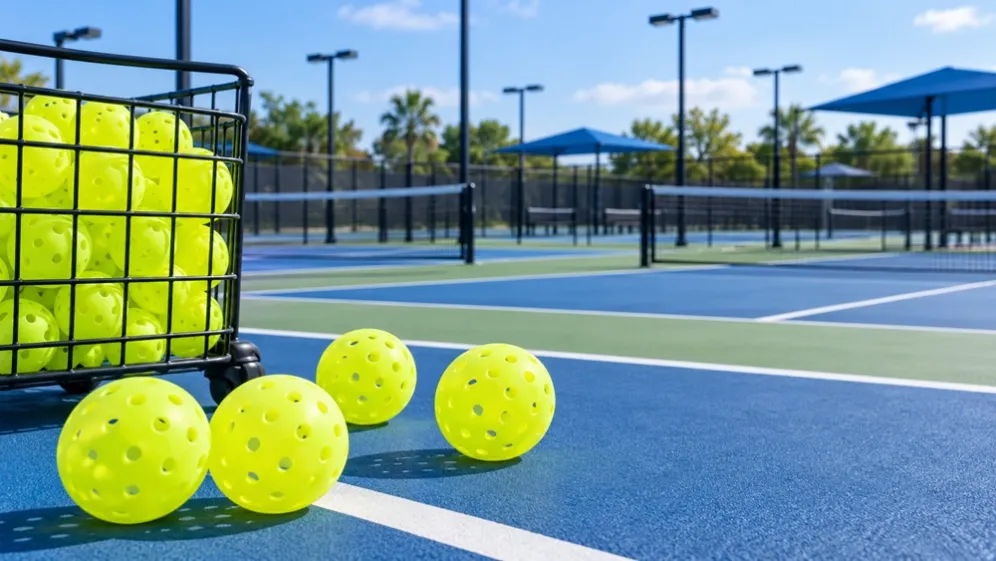
Managing a pickleball club involves more than maintaining courts and organizing games. One important operating expense that clubs often overlook is the regular replacement of pickleballs.
For facilities running multiple courts, group lessons, tournaments, and daily recreational sessions, the demand for pickleballs can add up quickly.
So, how many pickleballs should a club buy, and when does bulk purchasing become the better option?
This guide explains how clubs and multi-court facilities can estimate their pickleball requirements, manage replacement costs, and choose a suitable bulk supplier.
1. Why Do Pickleball Clubs Need a Regular Supply of Balls?
Unlike paddles and nets, pickleballs are consumable equipment. They experience repeated impact against paddles and court surfaces.
Over time, pickleballs may develop:
- Cracks caused by repeated impact
- Changes in bounce characteristics
- Loss of roundness
- Reduced playing consistency
- Surface wear after extended use
The replacement rate depends on playing intensity, court conditions, temperature, and ball construction.
For clubs with multiple active courts, running short of usable balls can interrupt training sessions, recreational games, and scheduled events.
That's why ball purchasing should be treated as part of regular facility operations rather than occasional equipment replacement.
2. How Many Pickleballs Does a Multi-Court Club Need?
There is no single purchasing quantity that works for every facility.
A club operating three courts twice a week will have different requirements from a facility running twelve courts with several sessions per day.
To estimate your requirements, consider:
Number of active courts
More courts generally require a larger inventory of balls available for simultaneous play.
Operating frequency
Facilities operating daily will usually consume more balls than clubs holding only weekly sessions.
Type of activities
Coaching programs, training drills, tournaments, and recreational games can require different quantities of balls.
Average ball replacement rate
Outdoor conditions, player intensity, and the quality of the ball all influence replacement frequency.
Example: Estimating Monthly Pickleball Usage
Consider a hypothetical eight-court pickleball facility.
If the facility replaces an average of two balls per active court per day and operates five days a week:
Factor | Example |
|---|---|
Active courts | 8 |
Operating days | 5 per week |
Average replacement | 2 balls per court per day |
Weekly replacement | 80 balls |
Four-week replacement | 320 balls |
Three-month estimate | 960 balls |
This example is illustrative, not an industry-standard replacement rate. Actual consumption should be measured from the club's own operations.
For this facility, a bulk order of approximately 1,000 balls could cover around three months of replacement demand under the assumed usage pattern.
3. Is Buying Pickleballs in Bulk More Cost-Effective?
Bulk purchasing can offer several advantages for clubs that use pickleballs regularly.
Lower unit costs
Larger orders may offer better per-ball pricing compared with purchasing small retail packs repeatedly.
Reduced ordering frequency
Instead of placing multiple small orders throughout the season, facilities can plan inventory around estimated demand.
More predictable supply
Maintaining sufficient inventory helps clubs avoid unexpected shortages during busy periods.
Consistent product selection
Using the same ball model for training and regular club activities may help players maintain a familiar playing experience.
However, bulk purchasing should never be based on unit price alone.
A low-priced ball that cracks frequently may create higher replacement costs than a more durable alternative.
The important question is not simply how much each ball costs, but how much it costs to support regular court activity over time.
4. What Type of Pickleball Balls Should Clubs Buy?
For clubs purchasing 40-hole pickleballs, several product characteristics deserve attention.
Durability
Balls should be evaluated for cracking, deformation, and changes in playing performance after repeated use.
Consistent Bounce
A predictable bounce helps players enjoy more consistent training and recreational sessions.
Roundness and Hole Construction
Ball geometry, hole distribution, and manufacturing consistency can influence performance.
Consistency Between Orders
For facilities purchasing the same model repeatedly, it is important to evaluate whether later batches meet the specifications and playing characteristics approved during the initial sample testing.
Tournament Requirements
If the balls are intended for sanctioned tournaments, buyers should verify the specific ball model's current approval status and suitability for the event.
Not every recreational club requires the same type of competition-approved ball.
5. Should Clubs Consider 40-Hole Rotomolded Pickleballs?
40-hole rotomolded pickleballs are one option for clubs purchasing balls for regular play.
Rotational molding produces a one-piece ball structure, and the finished product's performance also depends on material selection and manufacturing control.
For B2B buyers, useful sample evaluation criteria include:
- Bounce consistency
- Resistance to cracking during repeated use
- Roundness and shape retention
- Overall playing feel
- Performance under the facility's intended conditions
At Taimi Sport, we supply 40-hole rotomolded pickleballs for clubs, distributors, and sports businesses.
We encourage customers to evaluate samples under their actual playing conditions before committing to larger orders.
6. Can Pickleball Clubs Order Balls with Their Own Logo?
Yes. Custom logo pickleballs are an option for clubs that want to promote their facility, sporting organization, tournament, or brand.
Logo-printed pickleballs can be used for regular club activities, training programs, promotional events, or resale.
Taimi Sport supports custom black logo printing starting from 200 pieces for eligible pickleball models.
For buyers requiring larger quantities, we can also discuss bulk supply requirements and suitable customization options.
Final availability and pricing depend on the selected model, logo artwork, and order details.
7. What Should Clubs Ask Before Choosing a Bulk Supplier?
Before selecting a long-term pickleball supplier, club operators should ask several practical questions:
- Can I receive samples before placing a bulk order?
- Are the balls suitable for my facility's playing conditions?
- What are the prices for 500, 1,000, or 5,000 balls?
- Can the supplier support custom logo printing?
- What are the estimated production and shipping lead times?
- How is consistency managed between repeat orders?
- What information is needed to prepare a delivered-cost quotation?
A reliable sourcing relationship should help the club balance product performance, budget, replenishment frequency, and supply continuity.
8. Looking for a Bulk Pickleball Supplier for Your Club?
Whether you operate a single pickleball club or manage several facilities, finding the right ball supplier can make purchasing and inventory planning easier.
Taimi Sport supplies 40-hole rotomolded pickleballs for clubs, sports facilities, distributors, and private-label businesses.
We offer:
- Bulk pickleball supply
- Custom logo printing from 200 pieces on eligible models
- Sample availability for evaluation
- OEM and private-label sourcing support
- Quotations based on order quantity and destination
Planning Your Next Club Pickleball Order?
Tell us how many courts you operate, your estimated order quantity, and your destination country.
We can discuss suitable 40-hole pickleball options, sample requests, and bulk pricing for your facility.