
Oct 18, 2026Blog
Buying 40-Hole Pickleballs in Bulk: How to Switch Suppliers Without Losing Player Confidence
Changing your club's pickleball supplier? Explore player acceptance, replacement costs, and bulk ordering, with real feedback on Taimi Sport's 40-hole rotomolded balls.
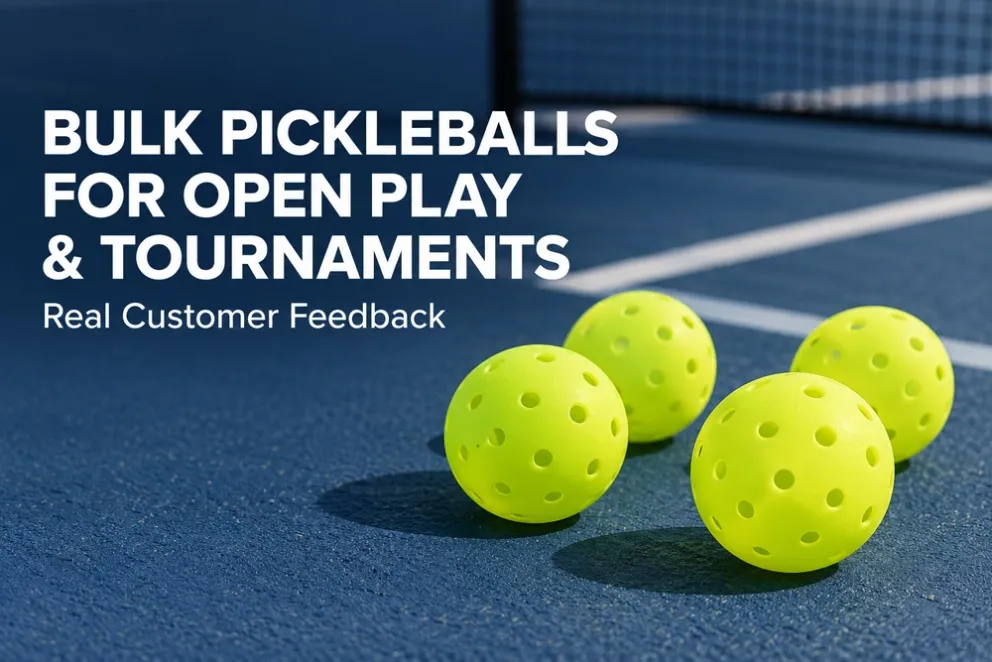
A lower quotation is a reason to consider a new pickleball supplier. It is not, by itself, a reason to put a new ball on every court.
For a club or court operator, the harder question is what happens after the switch. Will regular players accept the feel? Can the same model work for open play and planned competitions? Will savings on the purchase price remain savings after freight and replacements?
These questions make bulk pickleball purchasing different from buying a few balls for personal use. You are choosing a consumable that becomes part of the experience your business provides.
A recent Taimi Sport customer offered a useful example. After receiving our 40-hole rotomolded competition pickleballs, they confirmed that the balls were being used for both open play and their tournaments. Their response provides a starting point for discussing how another buyer can evaluate a supplier change.
A REAL CUSTOMER CASE: FROM DELIVERY TO ACTUAL COURT USE
The first message confirmed arrival:
“hello! the balls have been delivered already!”
The customer thanked us and added:
“i will be messaging again for more orders”
Later, we asked whether the players liked the balls. Their reply began:
“Hi!! We love the balls!”
They went on to say that they used the balls for open play and their tournaments, and thanked us for offering them great quality balls.
The relevant product detail is specific: this customer bought 40-hole rotomolded pickleballs for competition use.
The useful evidence is also specific. The balls reached the buyer, entered actual playing sessions, and received positive feedback. The customer expressed an intention to order again. This exchange does not provide a measured lifespan, a failure rate, or confirmation of a completed repeat order.
For a prospective buyer, the practical question is whether the same model meets the needs of their own players and purchasing plan.
WHY SWITCHING BALL SUPPLIERS CAN BE DIFFICULT FOR A CLUB
Regular players become familiar with the ball they use. A change can be noticeable during a soft shot near the net, a serve, or a faster rally. Even if a replacement looks similar, the playing experience may differ.
That creates a business decision for the buyer. A ball that is acceptable to a beginner training group may not be the preferred option for competitive club sessions. A model selected for general use may also differ from one specified by a tournament organizer.
Before requesting quotations, write down why you are considering a change. Is your current concern purchase price, availability, player complaints, frequent replacement, or the need for your own logo?
Then decide what must stay consistent and what you are willing to change. A clear brief helps a supplier offer a relevant model instead of simply quoting the cheapest ball available.
For example:
“We need a 40-hole ball for regular club sessions and local competitions. Our players prefer the feel of our current ball, but we want to evaluate an alternative supply option. We need samples before deciding on a bulk order.”
That inquiry gives a supplier more to work with than “best price for pickleballs.”
WHAT “40-HOLE ROTOMOLDED” TELLS YOU—AND WHAT IT DOES NOT
“40-hole” identifies the hole count. “Rotomolded,” short for rotationally molded, identifies the manufacturing process.
Rotomolded pickleballs are formed as a hollow, one-piece body. However, a construction description is only part of a buying decision. It does not establish that every ball made by that process has the same bounce, feel, shape retention, or usable life.
Two products can share a hole count and production method while performing differently. Ask for the exact model and available specifications, then evaluate the supplied samples.
Avoid choosing on appearance alone. For a club buying repeatedly, identifying the model clearly is useful when discussing later orders. Save the supplier's model reference alongside your sample notes so future discussions refer to the product you evaluated.
CAN ONE BALL SERVE BOTH OPEN PLAY AND TOURNAMENTS?
In this customer's case, the balls were being used in both settings. That is relevant feedback for buyers who want to evaluate one model across several activities.
Open play can show how a ball fits everyday use with different players. Competitive sessions provide another opportunity to assess whether players are comfortable with its response during matches.
If you hope to use one model for both, involve the people who make equipment decisions for each activity. Do not assume that acceptance during casual games automatically means acceptance by your tournament organizer.
For sanctioned events or competitions with a designated ball, confirm the applicable requirements and exact model eligibility before ordering event stock. The customer's tournament use described here is a usage report, rather than evidence of approval for every event.
HOW TO RUN A USEFUL SUPPLIER COMPARISON
A useful comparison should resemble the way your business will use the balls. You do not need an elaborate laboratory exercise to gather practical purchasing information, but you do need more than a few minutes of casual hitting.
Start with your current ball as a reference. Use the candidate model on the same court surface and, where practical, in comparable conditions. Include several players who regularly attend the sessions you are buying for.
Ask focused questions:
• Is the bounce comfortable for your usual game?
• Does the response feel predictable during soft shots and faster rallies?
• Are differences acceptable, or do they disrupt play?
• After repeated use, are there visible cracks or changes in shape?
• Would players willingly continue using this model?
Record how much each sample has been used. Keep unused samples separate from used ones. If a ball is retired, note why: cracking, deformation, a noticeable playing change, or loss.
These records help separate a product issue from a purchasing assumption. They also give you something concrete to discuss with the supplier if the model does not meet your expectations.
COMPARE COST USING YOUR OWN REPLACEMENT RECORDS
A quoted price per ball helps compare offers, but a club also needs to understand its cost of keeping usable balls on court.
Begin with the delivered cost: product price, freight, and any applicable import or handling charges. Then compare that with the usable playing time recorded in your own evaluation.
PLAN THE FIRST BULK ORDER AROUND A CONTROLLED INTRODUCTION
After sample acceptance, a first bulk order can introduce the product into normal operations. The appropriate quantity depends on your usage, available storage, budget, and replenishment lead time.
For a club considering a change, confirm:
• The exact ball model and agreed specifications.
• The quantity needed for the initial rollout.
• Whether balls are for internal use, resale, or an event.
• The expected dispatch timing and shipping arrangement.
• Any logo requirements and the approved artwork layout.
• How product questions or discrepancies will be handled.
Keep a record of the accepted samples and order details. When the shipment arrives, compare several balls with the reference samples before placing the full quantity into circulation.
You can also introduce the model to selected sessions first. This gives staff time to collect feedback and establish whether the product fits the wider program.
CUSTOM LOGO PICKLEBALLS: KEEP BRANDING AND PRODUCT EVALUATION CONNECTED
A club or emerging brand may want balls carrying its own identity. But a logo will not resolve a mismatch in playing feel.
Evaluate the underlying ball first. Then review how your artwork will appear on its curved surface. Lettering that works on a flat screen may need adjustment to remain legible on a ball.
Taimi Sport offers custom logo printing from 200 balls, mainly in black. Send your artwork for review and confirm the printing layout before proceeding. The 200-ball minimum refers to logo printing; ask separately about quantities for unprinted orders and samples.
DISCUSS YOUR NEXT ORDER WITH TAIMI SPORT
Taimi Sport is a sporting goods supplier supporting buyers sourcing 40-hole rotomolded pickleballs for clubs, venues, distribution, retail, and private label projects.
The customer's feedback shows one practical outcome: they received this model, used it for open play and tournaments, and told us they loved the balls. Your next step is to decide whether it fits your own use.
Email info@taimisport.com with your current purchasing concern, intended use, estimated quantity, destination country and postal code, and any logo requirements. If you have an event deadline, include the required arrival date.
Ask for samples of our 40-hole rotomolded competition pickleballs and a quotation based on your actual requirements.
Request 40-Hole Ball Samples & Bulk Pricing